
Wound healing is a complex biological process that depends on several factors, including tissue health, circulation, infection control, and the wound environment. While many minor wounds heal with conventional dressings and appropriate care, more complex wounds may require additional treatment strategies.
Negative Pressure Wound Therapy (NPWT) is an advanced wound management technique that uses controlled suction to remove excess fluid from a wound and create conditions that may support tissue repair.
Also known as vacuum-assisted closure (VAC) therapy, NPWT has become an established option in the management of selected acute, chronic, and surgical wounds.
As wound care technology continues to develop, new systems are being designed to address practical challenges associated with conventional equipment, including portability, ease of use, and treatment management.
Understanding how NPWT works, where it may be useful, and what limitations should be considered can help patients and healthcare professionals make informed decisions about wound care.
What Is Negative Pressure Wound Therapy (NPWT)?
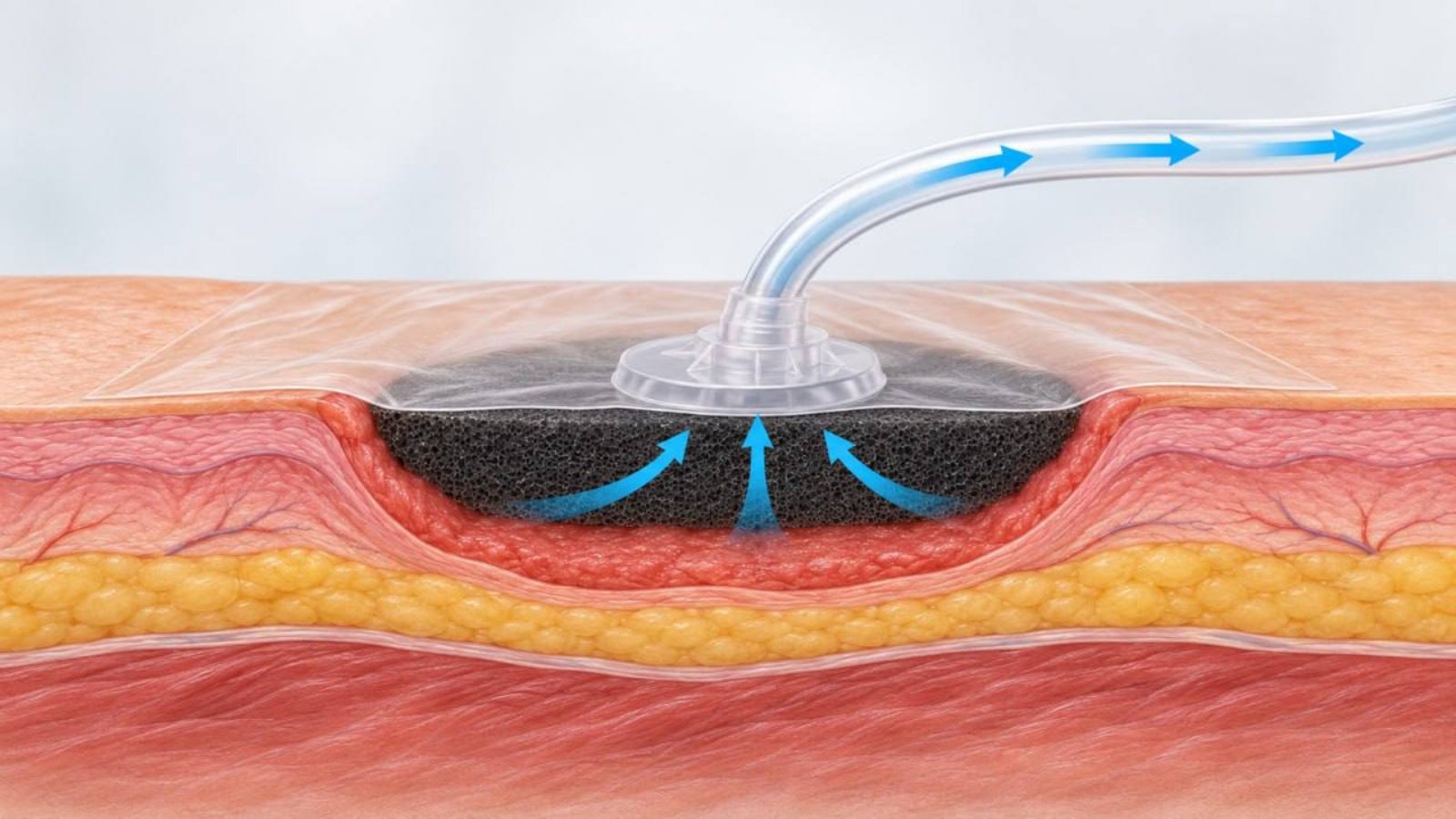
Negative Pressure Wound Therapy is a wound management technique that applies controlled pressure below the surrounding atmospheric pressure to a wound through a specialized dressing system.
The purpose is to manage wound fluid, support the formation of healthy granulation tissue, and help maintain a controlled wound environment.
Unlike conventional dressings that primarily cover and protect a wound, NPWT systems actively apply suction to the wound surface.
A typical NPWT system consists of several components:
- Wound dressing: A foam, gauze, or specially designed material placed over or within the wound, depending on the clinical application.
- Sealing layer: An adhesive covering that helps maintain a controlled negative-pressure environment.
- Suction mechanism: A powered or non-powered system that generates the required negative pressure.
- Fluid management components: Tubing and a collection canister or absorbent dressing components, depending on device design.
When the system is operating correctly, negative pressure is transmitted through the dressing to the wound area.
This approach is used in selected clinical situations where managing excess wound fluid and supporting tissue repair are important treatment goals.
According to the National Library of Medicine’s clinical overview of NPWT, negative pressure therapy has applications across several wound categories, although appropriate patient selection and wound assessment remain essential.
How Does Negative Pressure Wound Therapy Work?
NPWT works through a combination of fluid management and mechanical effects on wound tissues.
When negative pressure is applied through an appropriately sealed dressing, it produces several physiological responses that may contribute to wound management and healing.
1. Removal of Excess Wound Fluid
Wounds may produce exudate, a fluid containing water, proteins, inflammatory components, and cellular material.
Although some wound moisture is necessary for healing, excessive exudate can create problems. It may contribute to skin maceration, dressing leakage, and difficulties maintaining a stable wound environment.
NPWT helps remove excess exudate through controlled suction. Depending on the device, the collected fluid may be directed into an external container or retained within an absorbent dressing.
Managing excess fluid can help protect the surrounding skin and support wound care.
2. Mechanical Effects on Wound Tissue
Negative pressure creates mechanical forces at the wound surface.
Two important mechanisms are commonly described:
Macrodeformation refers to larger-scale tissue movement that may help draw wound edges toward each other.
Microdeformation refers to small mechanical changes at the tissue surface that may influence cellular responses associated with repair.
These effects are among the mechanisms proposed to explain how NPWT supports wound management. However, the magnitude of their clinical benefit varies depending on wound type, device characteristics, and patient factors.
3. Support for Granulation Tissue Formation
Granulation tissue is new connective tissue containing small blood vessels that develops during the wound-healing process. Its formation is an important part of repairing many open wounds.
By managing fluid and creating mechanical stimulation, NPWT may support conditions favorable to granulation tissue development.
Research into the mechanisms of negative pressure therapy has identified tissue deformation, fluid removal, and changes in the wound environment as important contributors.
4. Maintaining a Controlled Wound Environment
An effective NPWT dressing provides a sealed environment around the treated wound. The seal helps maintain negative pressure while limiting unintended exposure to the external environment.
However, a sealed dressing does not guarantee infection prevention. Wound assessment, appropriate cleaning, infection management, and proper dressing maintenance remain essential parts of treatment.
For a more detailed scientific discussion, see Negative Pressure Wound Therapy: Mechanism of Action and Clinical Applications.
What Types of Wounds May Benefit From NPWT?
Negative pressure therapy may be considered for several wound categories, depending on clinical assessment, wound condition, and the specific device’s intended use.
Surgical Wounds
NPWT may be used for selected surgical wounds, including wounds that have reopened after surgery or wounds that cannot immediately be closed.
Certain NPWT systems are also designed for use over closed surgical incisions in patients at increased risk of complications.
A Cochrane systematic review found that NPWT applied to closed surgical wounds probably reduces surgical site infections compared with standard dressings, although effects on other outcomes are less certain. These findings should not be generalized to every procedure or device.
Diabetic Foot Wounds
Diabetes can contribute to delayed wound healing through factors such as impaired circulation, neuropathy, and increased susceptibility to complications.
NPWT may be considered for selected diabetic foot wounds as part of a comprehensive treatment plan. Such care may also involve pressure offloading, vascular assessment, infection treatment, and management of blood glucose.
A Cochrane review identified potential healing benefits for some diabetic foot wounds, but rated the certainty of the available evidence as low.
Pressure Injuries
Pressure injuries develop when prolonged pressure, often combined with shear forces, damages the skin and underlying tissues.
NPWT is sometimes used for selected deeper pressure injuries. However, systematic reviews have found insufficient high-certainty evidence to establish clear healing advantages across all pressure ulcers.
Pressure relief, nutrition, infection management, and appropriate wound care remain fundamental.
Traumatic and Complex Wounds
Some traumatic wounds involve substantial tissue damage, fluid accumulation, or difficulty achieving immediate closure.
In appropriately selected cases, NPWT may be used after wound assessment and preparation to help manage exudate and support subsequent treatment.
Its use must account for exposed structures, bleeding risks, infection, and other clinical considerations.
Skin Grafts and Flaps
Certain NPWT systems may be used as specialized dressings over skin grafts or flaps. In these applications, the aim may include supporting dressing stability and managing fluid accumulation.
Appropriate use depends on the surgical procedure and the device’s specific indications.
What Are the Potential Benefits of Negative Pressure Wound Therapy?
NPWT offers several potential advantages in appropriately selected clinical situations.
Improved Exudate Management
Controlled suction helps remove excess wound fluid, which can be particularly useful in wounds producing substantial exudate.
Support for Wound Bed Preparation
NPWT may help support granulation tissue development and wound bed management before further treatment or closure.
Controlled Dressing Environment
An adequately sealed dressing can help maintain negative pressure and manage fluid within a controlled treatment system.
Potential Benefits in Selected Surgical Applications
Evidence suggests NPWT may reduce surgical site infection risk for some closed surgical wounds. However, the benefit depends on the procedure, patient population, and clinical circumstances.
Flexible Treatment Configurations
NPWT is available in several designs, including conventional powered systems and smaller portable or non-powered devices. This variety allows clinicians to consider different configurations according to treatment requirements and device indications.
Importantly, these potential benefits describe NPWT as a treatment category. They do not establish that every NPWT device produces the same clinical outcomes.
What Are the Limitations and Risks of NPWT?
Although NPWT is an established wound care technique, it is not suitable for every wound or patient. Clinical assessment is necessary before treatment begins.
Important Contraindications
Depending on the device and clinical circumstances, NPWT may be inappropriate in the presence of:
- Necrotic tissue with eschar that requires treatment or removal
- Untreated osteomyelitis
- Unexplored or certain abnormal fistulas
- Malignancy within the wound
- Exposed blood vessels or other vulnerable structures without appropriate protection
- Certain exposed nerves, organs, or surgical connections
Contraindications must be evaluated against the specific device’s instructions and the patient’s clinical condition.
Potential Complications
Recognized risks can include bleeding, pain, skin irritation, tissue damage, retained dressing material, and problems associated with loss of the dressing seal.
Significant bleeding is a particularly important safety concern.
The FDA’s guidance for non-powered NPWT devices identifies bleeding, exposed anatomical structures, infection-related considerations, and device labeling as important safety issues.
Clinical Monitoring Remains Essential
NPWT does not replace wound cleaning, debridement when indicated, infection treatment, adequate circulation, or management of underlying health conditions.
Patients receiving NPWT require appropriate monitoring by qualified healthcare professionals. Treatment plans should be adjusted according to wound progress, patient comfort, and any emerging complications.
Is Negative Pressure Wound Therapy Always More Effective Than Standard Dressings?
Not necessarily.
Clinical outcomes vary according to the wound category, the treatment being compared, and the characteristics of the patient population.
For example, evidence supporting NPWT over closed surgical incisions differs from evidence involving chronic open wounds.
A large randomized controlled trial published in 2025 evaluated NPWT against usual care for surgical wounds healing by secondary intention, predominantly involving lower-limb wounds after vascular surgery.
The trial did not find clear evidence that NPWT shortened healing time compared with usual care in the studied population.
This illustrates why NPWT should not be described as universally superior to conventional wound dressings.
Evidence-based wound care requires matching the treatment approach to the individual clinical situation.
Traditional vs. Portable Negative Pressure Wound Therapy Systems
NPWT equipment has developed considerably since the introduction of modern vacuum-assisted wound treatment systems.
Conventional equipment commonly uses an electrically powered pump connected to the wound dressing through tubing. Depending on the design, the system may also include a separate fluid collection canister.
These systems can provide different pressure settings and treatment configurations suited to various clinical requirements.
However, the equipment may introduce practical considerations involving portability, tubing management, device setup, and patient mobility.
Portable NPWT systems seek to address some of these challenges. Some use compact battery-powered pumps, while others rely on mechanical or non-powered suction mechanisms.
Certain designs integrate fluid management into the dressing rather than requiring a separate external collection container.
| Feature | Conventional NPWT | Portable or Integrated NPWT |
|---|---|---|
| Suction mechanism | Commonly an external powered pump | Compact powered or non-powered mechanism |
| Tubing | Common in many systems | Varies by device |
| Fluid collection | Often an external canister | Canister or dressing-based collection |
| Portability | Depends on system size | Often prioritized in design |
| Clinical applications | Depends on device indications | Depends on device indications |
These differences describe general design approaches, not guaranteed differences in healing effectiveness.
Device selection should consider wound type, exudate volume, clinical monitoring requirements, safety features, and approved indications.
How Is NPWT Used in Clinical Practice?
Negative pressure therapy is typically delivered as part of a broader wound management plan.
The general clinical pathway includes several stages.
Wound Assessment
A healthcare professional assesses the wound’s underlying cause, depth, condition, infection status, blood supply, and relevant patient risk factors. The clinician determines whether NPWT is appropriate.
Wound Preparation
Depending on the wound, preparation may include cleansing, removal of nonviable tissue, management of infection, and protection of surrounding skin.
Dressing and System Selection
The healthcare team selects a suitable dressing and NPWT device according to the wound’s needs and the manufacturer’s instructions. Application and pressure management should be performed by appropriately trained personnel.
Treatment Monitoring
Clinicians monitor the wound, dressing seal, fluid management, patient comfort, and any complications. Dressing changes and treatment duration depend on the individual wound and clinical plan.
Ongoing Evaluation
Wound progress is reviewed regularly to determine whether NPWT should continue, be modified, or be replaced by another treatment approach.
Patients should not independently alter device settings or treatment procedures outside their healthcare team’s instructions.
The Role of Innovation in Modern Wound Care
As healthcare delivery increasingly involves outpatient and community-based settings, the practical design of wound care equipment has become an important consideration.
Traditional NPWT systems can be effective tools, but their use may involve equipment management, external components, and training requirements.
Manufacturers are exploring ways to simplify these systems while maintaining appropriate performance and safety.
Areas of innovation include compact suction mechanisms, integrated dressing designs, alternative fluid management approaches, and improved portability.
These developments may help address practical challenges experienced by clinicians and patients.
However, a smaller or simpler device is not automatically more clinically effective.
New designs must be evaluated for pressure delivery, reliability, fluid handling, patient safety, usability, and clinical performance.
How VacuAid Is Approaching NPWT Innovation
VacuAid is developing an integrated approach to negative pressure wound therapy that focuses on simplifying the physical configuration of the treatment device.
According to the company’s technology description, its design incorporates a manually operated suction mechanism within a cover positioned directly over the wound dressing.
This approach is intended to reduce reliance on separate external pumping components while providing a more compact configuration.
The company identifies equipment complexity, portability, and ease of use as important challenges in conventional wound care technology.
Its development approach reflects a broader interest in making NPWT systems more integrated and manageable.
As with any new medical device, product-specific clinical performance, safety, regulatory status, and appropriate use must be established through the relevant evaluation processes.
Clinical findings from conventional NPWT systems should not be assumed to demonstrate equivalent performance for VacuAid’s proprietary design.
Learn more about the challenges associated with NPWT technology and explore VacuAid’s integrated wound care approach.
Frequently Asked Questions About Negative Pressure Wound Therapy
The main purpose of NPWT is to manage wound fluid and provide controlled negative pressure to support the wound-healing environment. It may help promote granulation tissue formation in appropriately selected wounds.
The terms are closely related. Vacuum-assisted closure, often abbreviated VAC, is commonly used to describe negative pressure wound therapy. NPWT is the broader term for the treatment approach.
NPWT may improve healing outcomes in certain clinical situations, but benefits vary by wound type and patient population. Some studies have not demonstrated faster healing compared with standard care. It should not be assumed to accelerate every wound’s healing.
Some NPWT systems are designed for use outside hospitals, including home-care environments. Suitability depends on the device, the wound, the patient’s condition, and arrangements for clinical supervision and support.
Some patients may experience discomfort during therapy or dressing changes. Pain varies according to the wound and device. Persistent or increasing pain should be evaluated by a healthcare professional.
Powered NPWT systems use electrically driven suction mechanisms. Non-powered systems generate negative pressure through mechanical or other non-electrical methods. Their features, operating characteristics, and clinical indications vary by device.
No. NPWT is not appropriate for every chronic wound. The underlying cause, circulation, infection status, wound structures, contraindications, and treatment goals must all be considered before selecting therapy.
Conclusion: Understanding the Value of NPWT in Wound Care
Negative Pressure Wound Therapy is an important option in modern wound management. Through controlled suction and specialized dressing systems, it can help manage exudate and support conditions associated with tissue repair.
Its clinical value depends on appropriate wound selection, device performance, professional assessment, and ongoing monitoring.
Research continues to clarify which patients and wound categories benefit most from this approach.
At the same time, advances in compact and integrated medical device design are creating opportunities to address some of the practical challenges associated with traditional NPWT equipment.
VacuAid is exploring one such approach through its integrated manually operated suction design.
To learn more about the company’s technology and development direction, visit the VacuAid Solution page.
Scientific References
1. Zaver V, Marietta M, Kankanalu P. Negative Pressure Wound Therapy. StatPearls Publishing. Updated February 21, 2026. NCBI Bookshelf.
2. Negative Pressure Wound Therapy: Mechanism of Action and Clinical Applications. 2021. PubMed.
3. Cochrane. Dressings That Use Negative Pressure for Closed Surgical Wounds. Cochrane Evidence Review.
4. Cochrane. Negative Pressure Wound Therapy for Treating Foot Wounds in People With Diabetes Mellitus. Cochrane Evidence Review.
5. Negative Pressure Wound Therapy Versus Usual Care in Patients With Surgical Wound Healing by Secondary Intention (SWHSI-2). Randomized controlled trial, 2025. PubMed.
6. U.S. Food and Drug Administration. Non-Powered Suction Apparatus Device Intended for Negative Pressure Wound Therapy (NPWT): Class II Special Controls Guidance. FDA Guidance.
Medical information disclaimer: This article is for educational purposes only and is not a substitute for professional medical advice, diagnosis, or treatment. NPWT should be selected and managed according to clinical judgment and the applicable device instructions.